Grand Voyager
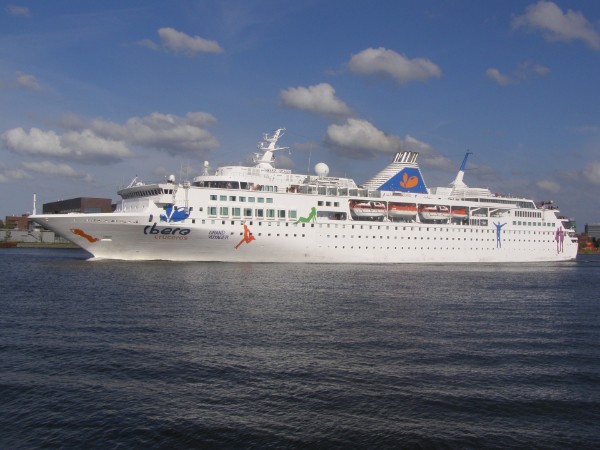
At the end of the 1990's, the Greek combine Royal Olympic Cruises sailed with a selection of well-maintained and popular, but older cruiseliners. The company knew they also had to modernize, so they ordered a couple of new cruiseliners from the great Blohm & Voss yards in Hamburg, Germany. Because their passengers were known to the small-sized ships within the fleet of ROC, these new ships would also be quite small, measuring just under 25.000 tons. Although ROC did not have a true naming strategy some of the ships of the company had their name started with 'Olympic' and the new duo of ships would follow this. The ships were the first newbuilds for ROC and the first one was launched at the 14th of july 1999 under the name of Olympic Voyager. The second one was to be named Olympic Explorer and she floated out at the 19th of may 2000.
Olympic Voyager was built as yardnumber 961 and her tonnage is 24.391. She has a lenght of 180,40 meters, she is 25,5 meters wide and her draft is 7,30 meters. Her maximum passenger capacity is 836 and her crew capacity is 360. The ship was, like her later sister, designed to be fast with a service speed of 28 knots. Her maximum speed is 30,6 knots and this certainly made these ships among the fastest cruiseships afloat. The ships were meant for a 'Three continents in a week' service (Europe, Asia and Africa) and this required the speed. The ship was delivered to ROC at the 15th of june 2000 and she was named at Piraeus, also her homeport, at the 22nd of june. Due to political unrest in the region where she was supposed to sail, the Red Sea and the Eastern Mediterranean, she started sailing the Mediterranean only, her first cruise departing from Piraeus at the 24th of june. She sailed a series of 7-day cruises calling at seven ports. In winter, her cruises departed from Fort Lauderdale in Florida, from where she sailed the Caribbean and longer cruises up the Amazon river. After this, her departureport changed to Houston, Texas.
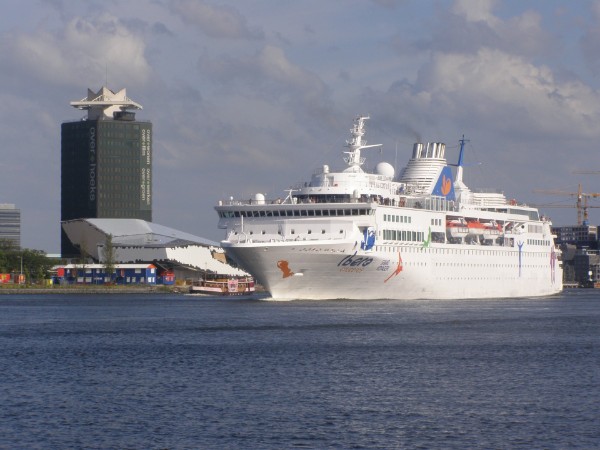
Problems arose for Royal Olympic Cruises in 2001, when the International Olympic Organisation claimed the right of the word 'Olympic' and the cruisecompany had to change its name, although their initials could stay the same. The company was restyled as Royal Olympia Cruises. But not only the name of the company had to change, but also the names of the ships. So Olympic Voyager was renamed Olympia Voyager and her new sister, that was at the finishing stages of building, entered service as the Olympia Explorer. But much darker clouds were hanging in the air above Piraeus when the company that had been set up to finance the building of the new ships was filed for bankrupcy in december 2003. The ship was laid-up at St. Thomas because bills could not be paid. In the aftermath, the whole company of Royal Olympia Cruises had to file for bankrupcy and despite a small and short-lived restart that was made in 2004 it spelled the end for ROC. The Olympia Voyager had to land her passengers at Port Everglades at the 2nd of january 2004 and this was her last act for her company. She was laid-up at Miami now and taken over by the German creditors in march 2004. She was auctioned the following may and renamed Voyager for Horizon Navigation Inc. of Nassau, a division of V-Ships, the former owners of Sitmar Cruises. The ship was chartered for two years, with an option to extend the charter for a longer time, to the Spanish operator Iberojet, a part of Orizonia Corporation, the biggest travel company in Spain.
Her first cruise for the Spanish market started at the 28th of june 2004 at Valencia and she started sailing the Mediterranean for Iberojet. Something really absurd happened in the first months of 2005, when both Voyager and her sister Explorer (now owned by the Unversity of Pittsburgh) were damaged severely due to freakwaves. It happens more, but for two sisterships to be struck by these giant waves within little more than 20 days and in different parts of the world it is very awkward. The first to meet a wave was Explorer near the Aleutian Islands in the north Pacific ocean on the 26th of january. The wave measured 15 meters in height and water poured in through cracked bridgewindows causing the machinery to be stopped. The ship, crew and the student passengers survived luckily. On the 14th of february, just 19 days later, Voyager was also hit by a giant wave, cruising between the Balear Islands and Sardinia in the Mediterranean. The story was exactly the same, the wave cracked the bridgewindows, water stopped the engines but the ship and everyone on it survived. It took a few hours to get two of the four engines running again and the ship maked her way for the port of Cagliari, Italy. She was finally repaired at Genoa and resumed cruising in april.
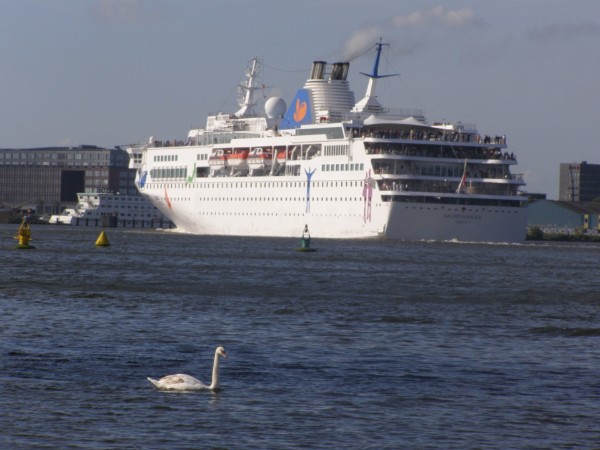
The charter was extended and now also the owners changed. Who do you think that might be right now? Good guess, Carnival Corporation signed a letter of intent with the owners of Iberojet, now renamed Iberocruceros to develop the growing Spanish cruisemarket. Carnival bought 75% of Iberocruceros and the other 25% was to be owned by Orizonia. The meaning was that older tonnage of Carnival could be used to extend the Iberocruceros fleet and it did, because Carnival transferred Celebration and Holiday over to the company under the names Grand Celebration and Grand Holiday. Voyager, that was already marketed under the name Grand Voyager, was also officially renamed in this style at the end of 2005. Carnival Corporation did place the management of Iberocruceros in the pocket of Costa Cruises of Italy, mostly because of their knowledge of the European and the Mediterranean markets. Costa Cruises aquired the remaining 25% of shares in Iberocruceros from Orizonia in 2009 and so the company is now fully Carnival owned.
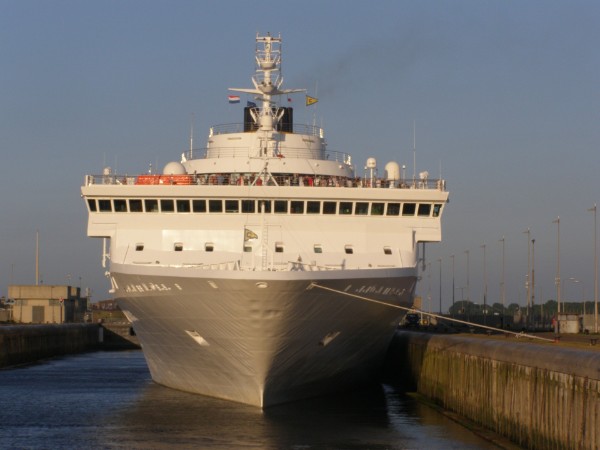
At the end of 2011, from december onwards, Grand Voyager was replaced in the fleet of Costa Cruises for a series of 7-day Red Sea cruises together with Costa Allegra. Costa Marina was planned to take over from both of these ships, sailing throughout 2012 in the Red Sea. For Costa, Grand Voyager was renamed Costa Voyager and although it was planned for the ship to be back with Iberocruceros from the beginning of 2012 onwards, her services for Costa continued into 2013 and the beginning of 2014.. Because of the fire that severely damaged Costa Allegra (so bad she was scrapped), her intended Red Sea itineraries were suspended and Costa Voyager took over the cruises of Costa Allegra between march and july of 2012. This is why she was seen in northern Europe and the Mediterranean in this period. She departed Amsterdam on july 18th and sailed for the Mediterranean, after the cruises she took over were all sailed.
As Costa Voyager, the ship visited The Netherlands at the 18th of july 2013, on het way to Savona after the season of cruises she took over from Costa Allegra was over. She is seen here, just after she left the locks at IJmuiden.
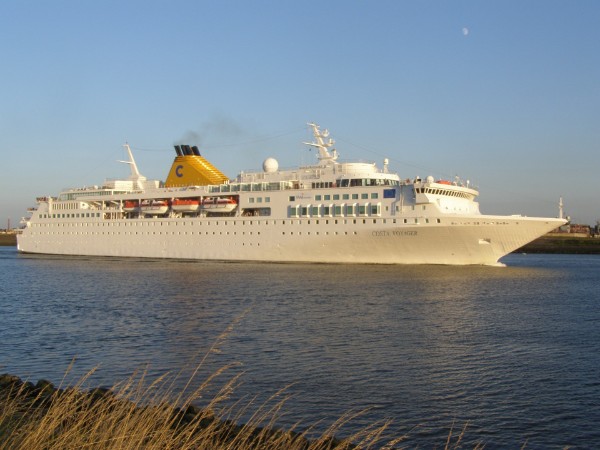
In february 2014, Costa Voyager was sold to the Chinese company Bohai Ferry Company on very short notice. It was expected that Costa Voyager was to be replaced in the Costa neoCollection in the coming years and the sale to China was a complete surprise. Also because Bohai is the largest operator of roro-passengershipping in China but they never operated cruiseships before. The company just started up a new venture based in Hong Kong for the creation of a cruiseline in 2013. It has to be said that China is a true growing market in recent years and that Chinese companies are starting up is not that of a surprise. The order for a 100.000-ton cruiseship for the new China Xiamen company was already placed. Untill now, western cruiselines seem to hold the greatest marketshare in the Chinese market, Costa being one of the largest. The new name for Costa Voyager and her destinations have yet to be announced.