Black Prince
Black Prince was built at the Flender Werke in Lubeck, Western Germany and the ship was launched at the 14th of may 1966. Het yardnumber had been 561 and she was built as an overnight ferry for Frederik Olsen & Co.. The ship had accomodations for 693 passengers and 200 cars on her ferryservices, but on cruiseservice she was sailing with 330 passengers. Her lenght was 141,64 meters, width 20,02 meters and her draft was 6,10 meters. She was measured at 9499 tons and her normal speed was 22,5 knots. She was the second ship of a pair of sisters, her older sister Black Watch was launched a few months before her, at the 5th of march of the same year. For both ships it was the second time the names were used within the history of the company.
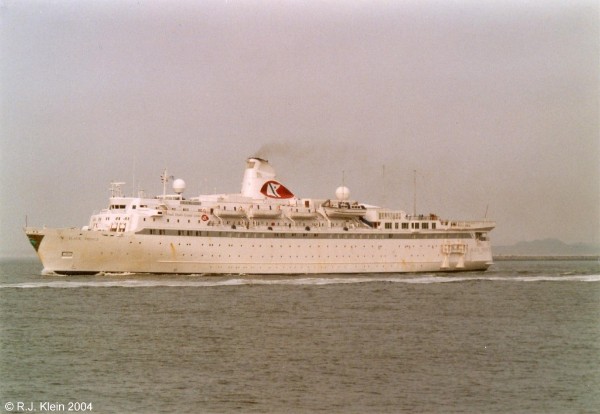
The Black Prince and Black Watch of 1966 were a totally new generation of passengerships for the company and started sailing a service between London and the Canary Islands. It was a weekly service, so a true ferryroute, but it was mostly advertized as a cruise too. They were not the first ships Fred. Olsen operated on this route, but they were intended to attract a new kind of passenger and they were also the biggest ships in the fleet. These sailings would only be sold during the winter months, during summer the ships were used by Det Bergenske Dampskibs Sellskap and for them Black Prince was named Venus and was sailing the service between Kristiansand, Amsterdam and Harwich. Black Watch as named Jupiter for Det Bergenske and sailed the service between Bergen and Newcastle. With these ships, Fred. Olsen established a very friendly and relaxed cruiseproduct that really became the cornerstone for the company. Since these ships, the company has a lot of repeat passengers, mostly slightly older in age, but who appreciate the social atmosphere found on these small cruisevessels. Not many problems were to be overcome in the early years, with the exception of a total engine failure in may 1973, after one of the ships propellers had hit the seabed.
In 1987, Fed. Olsen changed directions by selling Black Watch to Norway Line for further ferry services at the North Sea, not really renamed as Jupiter now all year round. Black Prince was not sold, although the ship was rebuilt as a full-time cruiseship at the Wärtsilä yards in Turku, Finland. Her new tonnage measure was 11.209 and she could now sail with 527 cruisepassengers served by 145 crew. Her new homeport became Manila and she started cruising from Southampton to the Mediterrannean and northern Africa. Her first cruise started at the 28th of february that year. She became a very popular and well-known cruiseship and in fact she now was the only cruiseship operated by Fred. Olsen. Next to this ship, the company still sailed a ferryservice with two ships, but this was discontinued and the ships sold in 1991. From this year on, Fred. Olsen is only a cruisecompany and Black Prince their only ship untill 1996, when the former Royal Viking Star was bought and renamed Black Watch. In 1990, a problem arose with the Swedish and Danish seafarers unions while the ship sailed some services between Copenhagen and Stockholm, because the company was using underpaid Filipino crewmembers on the route.
The company grew steadily over the years that came, adding new ships to the fleet every couple of years. The ships that were added to the fleet were older vessels, but they were rebuilt extensively before entering Fred. Olsen service. Black Prince became the oldest member of the fleet in every kind of way, although she still was very popular by her regular passengers. But in may 2009, just before the new SOLAS (Safety Of Lifes At Sea) regulations were put into action, the ship was sold to the SAVECA company of Venezuela. This because the ship would not be able to sail international waters under the new regulations after 2010. For SAVECA, she would only sail coastal services so for this she would not need a costly rebuilding. On the 9th of september 2009, the ship sailed on her last Fred. Olsen cruise and arrived back on the 11th of october. She was renamed Prins in november of that year and left for Venezuela. One month later, she was renamed Ola Smeralda but she had to be laid up because the was not granted a permit to sail. In january 2010, a new role was given to her as a accomodationsship for workers of a Mexican oilcompany. From april 2010 onwards,the ship was chartered by the United Nations for service as a housing ship for aid workers at Haiti after the devestating earthquake. This charter caused a stirr in bad publicity, because the ship had now ties with the not very popular Venezuelan president Hugo Chavez. In january 2013, the small but once one of the most popular cruiseliner in northern Europe was sold to the breakers.